| Designation |
Species |
Color |
Density g/cm3 |
Hardness |
Provenience |
| 1 |
Fir |
Yellow |
0,543 | Soft |
Lumberyard |
| 2 |
Spruce |
White |
0,373 | Soft | Lumberyard |
| 3 |
Birch |
White | 0,437 | Med |
Bookshelf |
| 4 |
Beech? |
White | 0,618 | Hard |
Australian sun
chair |
| 5 |
Oak |
Brown |
0,706 | Hard | Chair |
| 6 |
Jarrah? |
Red |
0,676 | Hard | Kitchen workbench |
| 7 |
Teak |
Brown |
0,738 | Med | Chair |
| 8 |
Mahogany |
Red |
0,495 | Soft | Yacht carpentry |
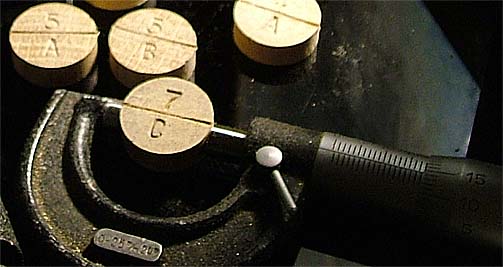 On
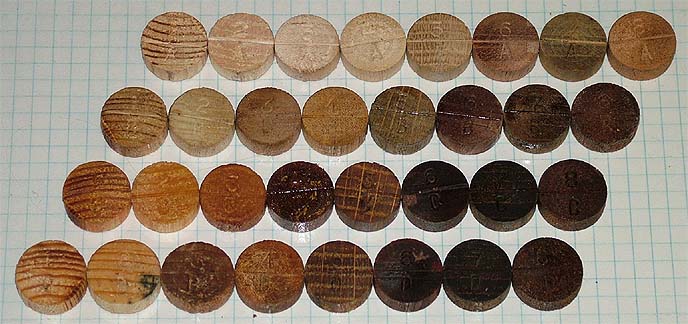
the flat side of each sample a diametrical shallow groove was filed
in the general direction of the year rings. This direction was hard to
determine
for species 4 and 8, possibly in error. The round shape makes it easy
to measure diameter separately along and across
the year rings, corresponding to the tangential and radial directions
in the growing stem.
On
the flat side of each sample a diametrical shallow groove was filed
in the general direction of the year rings. This direction was hard to
determine
for species 4 and 8, possibly in error. The round shape makes it easy
to measure diameter separately along and across
the year rings, corresponding to the tangential and radial directions
in the growing stem.| Design |
Treatment |
| A |
None, for reference |
| B |
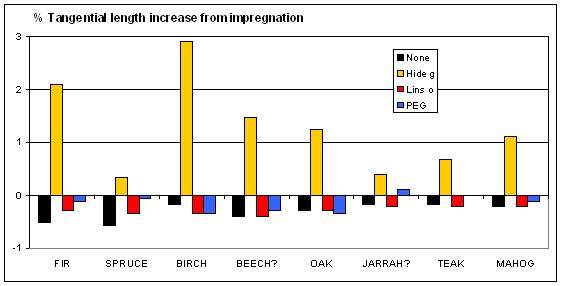
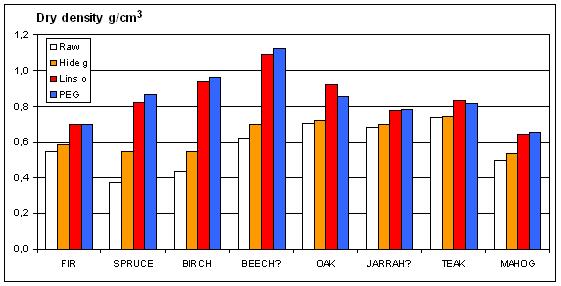
Hot hide glue. Classical style.
Acqueous gel,
partially filling and sealing the pores. Its water content makes the
samples change dimensions at impregnation and surface smoothness is
degraded. The water
content of the impregnant will evaporate to leave void pore cavities
after drying. |
| C |
Boiled linseed oil. Seaman
style. The absence
of water may allow for better filling of the pores. The oil hardens
from oxidizing in the following days/weeks. (In contrast to raw linseed
oil which does not harden). |
| D |
Polyethene glycol, PEG 1500.
Conservator style. Water soluble (though no water was used), melting
point in the 40 C
range, white substance with a fatty surface, looking like wax or
stearine. |